Is learning Japanese difficult for working abroad? How much time is reasonable? What is the importance of Japanese language skills when working in Japan?

Depending on the specific job order, the training time will vary.
Are you planning to participate in a labor export program to Japan to work and increase your income, but you’re wondering if learning Japanese is difficult? What are some effective Japanese learning experiences and how long does the training take to pass the selection exam?
Let’s explore these topics with Nhat Huy Khang in the article below.
What exactly do you learn when studying Japanese for labor export to Japan?
A mandatory requirement for working in Japan through these job orders is Japanese language proficiency. Without Japanese language skills, you won’t be eligible to participate in the selection exams in Japan.
Besides that, Japanese language skills not only help you pass the selection exams for job orders in Japan, but also make your life in Japan more convenient.
So, what exactly do you learn when studying Japanese for labor export to Japan?
Japanese used in daily communication and activities
Kanji (Chinese characters)
Specialized Japanese vocabulary for specific job orders in Japan
Japanese vocabulary related to policies, laws, and qualifications for working in Japan
Japanese language requirements for working in Japan through labor export programs

Japanese language proficiency is one of the requirements for 99% of overseas employment orders.
Besides health, height, weight, and age, Japanese language proficiency accounts for 99% of job requirements for Japanese workers, as well as for the Specified Skills Examination.
Specifically, Japanese companies always require applicants to study Japanese before departure.
This is because, for the Japanese, only when you understand and speak Japanese well can you perform your assigned tasks effectively. It’s especially important for improving language skills in communication to find solutions in the workplace.
Depending on the specific job order, Japanese companies will have different requirements for Japanese language proficiency. You should aim for a specific job order and then plan your language learning accordingly.
Knowing Japanese beforehand is also a way to make a good impression and significantly increase your chances of getting hired.
The Importance of Learning Japanese for Overseas Employment

Knowing Japanese offers many great benefits when living and working here.
Many workers have the mindset of wanting to leave as quickly as possible, hoping for the best chance of earning income. However, this is a misconception that will cause you to lose more than you gain in the future. Specifically, the importance of learning Japanese for overseas employment is clearly demonstrated as follows:
Japanese is extremely important during your daily life and work in Japan. Understanding the language of this country gives you many advantages when working. It also helps you understand instructions and communication from your supervisor.
Furthermore, living in a foreign country with a language barrier is extremely inconvenient and difficult. Japanese plays a role in balancing and improving your quality of life in Japan because now you can easily communicate, shop, and move around the city.
On the other hand, good Japanese communication skills help you integrate into life and connect with people more quickly. This will make your experience in the Land of the Rising Sun much more enjoyable.
Fluent Japanese helps you gain more trust from your Japanese superiors. They will trust you, promote you, and frequently assign you tasks. This will give you the opportunity to earn a higher income or get promoted.
How long does it take to learn Japanese before going to work abroad?

The duration of the course varies depending on the specific job requirements.
If you’re confused and struggling to figure out where to start learning Japanese for overseas employment, and how much to learn, rest assured that most job orders don’t require Japanese language proficiency before the selection process.
Instead, the sending companies will arrange for you to participate in a basic Japanese language course immediately after you’re selected. This offers absolute convenience for workers, making it easier for them to apply for overseas employment in Japan.
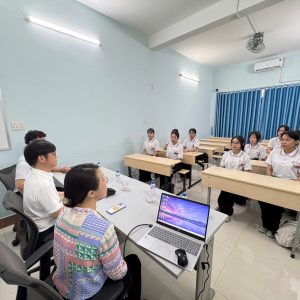
This course usually lasts from 4 to 5 months. Some unions also require trainees to complete up to lesson 30 before being allowed to leave.
However, many companies accept workers for expedited overseas employment even after only 1-2 months of study. This depends on whether the specific job order requires extensive Japanese language skills.
Don’t let a little time or money deter you from learning Japanese for overseas employment. This is one of the factors that will make your work smoother and more successful.
Furthermore, with the Japanese language skills you prepare, you’ll have the opportunity to learn more about Japanese people and culture. This will help you build better relationships in this beautiful country.
Sharing experiences on learning Japanese quickly and effectively for overseas employment:
Determine your Japanese language learning and exam goals.
As mentioned above, each job order will have its own Japanese language requirements; not all orders are the same.
Besides your current Japanese language level, your goals for working or studying in Japan will also determine the training programs you choose.
For workers, you can learn the basics to meet the exam requirements of the job order. Anything that isn’t necessary can be learned later after arriving in Japan.
Try and find effective learning paths for yourself.
If you study at a language center, they will have a standardized learning path for you and hundreds of thousands of other applicants. This may be effective to a certain extent.
However,
If you want to develop and understand the language even better, try exploring and searching for new learning paths and methods that help you become familiar with and use the language more easily and proficiently.
Practice whenever you can.
Frankly speaking, learning Japanese for work abroad or any other language has one thing in common: the more you practice, the better you become.
With a difficult language like Japanese, practicing listening, speaking, reading, and writing every day will help you become familiar with it and help your brain remember the characters faster and longer than following a basic learning path.
Create an environment where you can use Japanese by watching Japanese videos, thinking in Japanese, having Japanese monologues, and practicing writing in Japanese. This is a tip that will make you stand out from other candidates.
Can I apply for a job in Japan if I don’t know Japanese?
Absolutely! As soon as you participate in the Japanese labor export program at Nhat Huy Khang and are selected, we will provide Japanese language training to help you feel more confident in the interview with Japanese factory owners.
If you need any further information regarding learning Japanese for labor export, message Nhat Huy Khang or refer to other articles on our website: https://www.nhhk.com.vn